
CFCWR Blog

Students in Action: Universities Pioneering the Movement to End Campus Food Waste
Written by: Mateo Dasso, CFCWR Student Intern, Purdue University
Discovering the Hidden Problem on Campus
Food waste is a growing concern that affects the environment and the economy. It is also a humanitarian issue: one-third of the food we produce is wasted, while millions of people are hungry.
College campuses are not immune to this problem. One estimate showed annual edible food waste of 110 pounds per student in campus dining – twice the amount if corporate dining cafeterias. That is a lot of meals ending up in the trash, while many students struggle to afford food. The good news – university administration and student-led organizations are stepping up, finding solutions for those in need, and implementing strategies to conserve food and build a more sustainable future. With data, composting, and food recovery initiatives, campuses are showing how change starts at the table.
Campus Food Waste Movement
Universities worldwide are recognizing that reducing food waste is necessary and environmentally beneficial, but they face a unique challenge. They are significant food producers of a wide variety of menu options, but predicting exactly how many people will show up—and what they’ll eat—isn’t easy. The result? An oversupply of prepared food for service and thousands of meals uneaten each semester.
To help battle this issue, many universities measure food waste using AI-informed technology from companies such as Leanpath, Winnow, and Orbisk. These systems make it easy for foodservice operators to analyze food waste and make future adjustments in meal planning and production. Coupling these food-waste monitoring systems with advancements in forecasting food demand can help campus dining become more precise and conserve more food. For example, a 2025 study by Dr. Gul Fatma Turker suggested that machine learning methods and data-driven models could improve campus dining forecasting. The researcher analyzed meal variety, the number of students, weather, and more to predict daily demand with 88.2-99.9% accuracy. When the model was implemented, the approach decreased food waste by 28%.
These technological innovations align with broader movements to reduce campus food waste. For example, popular food waste reduction initiatives include trayless dining, reducing plate size, adjusting portion sizes, and raising awareness with foodservice staff and students. Universities are also repurposing food by donating it and composting it. (See research by Filho et al., 2021, Filho et al., 2023, Grech et al., 2020, and Musicus et al., 2022). But, students are not sitting back and watching. They are engaged! An international research study found that 58% of students supported food waste initiatives at the 52 universities surveyed. Programs like Swipe Out Hunger, Food for Free, and Food Recovery Network make it easier for students to partner with the institution to rescue surplus food, reduce landfill waste, and more.
Real World Examples
Universities in the U.S. and other countries are taking action by integrating students’ actions, data, and local partnerships to drive change. Here are some examples showing that reducing food waste is not only an environmental initiative but also a cultural transformation on campuses.
A Purdue University professor is working with Indy Hunger Network to use AI and smart tracking to automate matching surplus food donations with food banks, reducing food waste while addressing hunger in Indiana. Additionally, the University’s Sustainability Department partnered with Purdue Athletics, Levy Restaurants/Boilermaker Hospitality Inc., Purdue Food Co., and the City of West Lafayette to collect food waste from campus sports venues like Ross-Ade Stadium and Mackey Arena, as well as the Purdue Memorial Union, sending it to the city’s anaerobic digester to generate energy.
OSU students have shown their commitment to reducing food waste by helping launch a public food scrap collection site. The aim is to provide a convenient way to handle organic waste so it doesn’t end up in the landfill. Student-volunteers assisted with peer-to-peer education, training sessions, and more. Through the program, OSU collected 600 additional tons of compost in 2022 through 2023. To handle higher volumes of organics, the University partnered with the Ohio Department of Rehabilitation and Correction to turn waste into a social impact pathway. In 2023, Ohio State University was a winner in the Campus Race to Zero Waste for this initiative.
Northeastern students developed the “Sustainabite” project to reduce dining hall food waste by 25-30%. Their research showed that oversized portions and unfamiliar dishes were the main problems. They proposed different solutions like “Taste 2 Try,” which featured smaller portions and sampling stations so students could experiment before committing to a full plate.
In 2025, a team of students interested in nutrition and dietetics created a campus-wide pilot to map food waste and composting. They are working closely with faculty, community gardens, and a local farm – Airfield Farm Estate – transforming leftovers into compost. Want to guess the most commonly plate-waste foods? Vegetables and starches!
At this campus, you will find bins to collect food waste. The waste is then processed through an anaerobic digester at a local facility. The scraps are turned into fertilizer, livestock feed, and biomethane for heat and electricity. Additionally, they partnered with the app Too Good To Go starting in 2022, and each week the campus cafeterias sell “magic bags” containing items that would otherwise go to waste.
In the 2024-25 academic year, the University collected 196.4 tons of food waste on campus. They processed the waste through anaerobic digestion, which is then sent to another facility where it is converted into biogas and fertilizer.
Many universities have implemented systems to alert students about free leftover food, aiming to reduce food waste from catered campus events. For example, students, faculty, and staff at the University of Texas at Austin are notified via an App when extra food is available, and recipients have 30 minutes to pick it up. Students at the University of California, Irvine, created a notification system called Zot Bites to alert students about leftover food from catered events. They modeled this on similar systems at other California universities, such as Food 4 UCSF Students and Titan Bites. With studies suggesting that 30 to 40% of students are food insecure, these initiatives are key to feeding hungry people while preventing food waste.
These examples are just a few of the variety of approaches taken to conserve food and reduce waste at universities. From data collection to food recovery to compost collection — when campuses work together towards sustainability, they can create better dining systems and reduce food waste.
How to get involved
Are you a college student or know one? If so, act now or encourage the student in your life to do so. Even if you aren’t a student (or know one), many of the ideas below can be implemented at K-12 schools, worksites, hospitals, and other venues. Use and adapt these simple ideas to make a difference.
- Start by volunteering with a campus food waste reduction department or a local pantry.
- Join a campus Food Recovery Network chapter or Food Waste Reduction team. Don’t have one? Then start one! Look to rescue meals from foodservice and deliver them to shelters or pantries.
- Collaborate with university faculty for ongoing research. Gather data, survey your friends.
- Raise awareness by sharing data that highlights the environmental and economic costs of food waste. Our Resource Library is a great place to find information!
- Emphasize sustainable policies in dining halls and other foodservice outlets and contribute to food waste reduction goals on campus or in other venues.
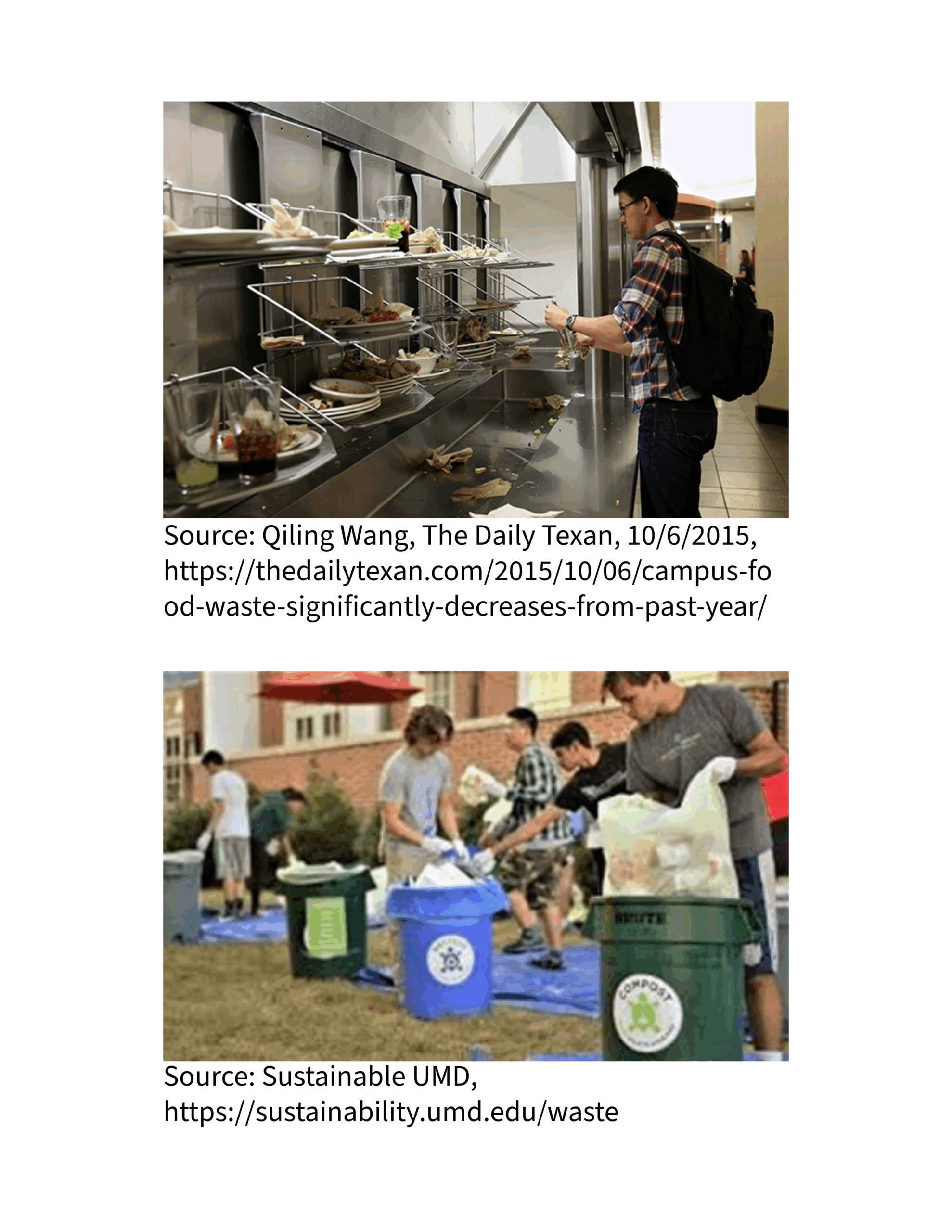
And the simplest tip of all: only take what you’ll eat. You can always go back for more!
Remember — small acts are meaningful and add up to a bigger change when everyone participates.
Conclusion
Every campus has its own story, but they share common values, including connection, responsibility, and the belief that change is possible. Universities and colleges stand at the center of impact through innovation, where dining halls and other foodservice operations can function as laboratories for sustainability, and students can become the fuel for global and environmental change. They connect the valuing of resources, community, and the next generation.
The United Nations set a goal to halve global food waste by 2030. That won’t happen through government policy alone. Instead, it will take all of us working together for a common goal of food conservation and waste reduction. Universities can take the lead by working alongside volunteer student initiatives and partnering with faculty to research new solutions, moving us toward a more sustainable future.
So, what’s your next move? Whether you start small by taking smaller portions or go big by launching a food conservation and waste reduction initiative, you’re part of the solution. That’s powerful!
This work is supported by the Agriculture and Food Research Initiative, project award no. 2024-68015-42110, from the U.S. Department of Agriculture’s National Institute of Food and Agriculture. Any opinions, findings, conclusions, or recommendations expressed in this publication are those of the author(s) and should not be construed to represent any official USDA or U.S. Government determination or policy.