
CFCWR Blog

Written by: Mateo Dasso, Student Intern, and Karen Byrd, PhD, RDN, Research Administrator and Outreach Coordinator, Purdue University, CFCWR
If you’ve ever tossed out food based on a date stamped on the package, you’re not alone. Most of us have. But here’s the thing: those dates are not what we think they are. They’re not federally mandated safety deadlines. They’re not expiration dates. And they are almost certainly causing us to throw away a lot of perfectly good food.
Join us in looking into what those labels actually mean, why the system is so confusing, what’s being done about it, and what you can do right now to waste less and save more.
Breaking Down Date Labels
Dates first appeared on food packages around the 1920’s as a way for shoppers to gauge food freshness. Consumer demand, manufacturer responses, and state and federal legislation and guidance have brought us to where we are today— 50 variations of date labels in the U.S. – wow! That’s a lot! However, only a few are commonly seen on foods on our grocery shelves.
There are two broad categories of codes: “closed” and “open.” Ever see a seemingly weird series of letters and numbers stamped on the tops or bottoms of cans? That’s likely a closed code. They’re not intended for consumers; instead, they’re manufacturer-specific tracking tools that indicate production dates and help retailers with stock rotation and product recall tracking. While many manufacturers use what is called a “Julian Date Code,” there is no universal industry standard for these codes. So, unless you work in food distribution, you can just ignore them.
What we encounter most as everyday shoppers is “open” date labeling. The dates themselves are easy to read, but their meaning is not always so clear. Here are what some of the most common ones currently mean:
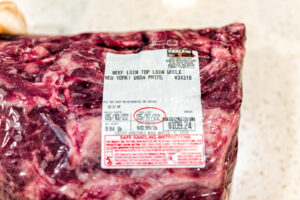
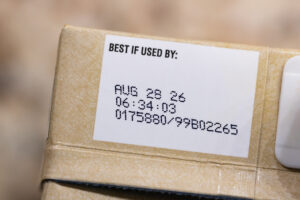
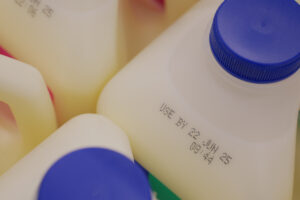
So, the question on everyone’s mind is, can I eat something after the date on the food? Generally, for labels that aim to communicate product quality, the answer is “yes” as long as it is stored properly and shows no signs of spoilage. For example, milk stored in the fridge may last longer than the date. Eggs can also last for 3 to 5 weeks past the date if refrigerated properly. Pantry items like rice or pasta can last for years. Just know that the product may have lost some of its peak flavor or texture – that is, those chips may not be as crispy, and your cereal may seem stale — but that does not mean they are unsafe to eat. For “Use-by,” it is not clear whether to toss or taste after the date. Instead, use your senses to check for spoilage.
Wait – I’m still a little confused!
….well, you are not alone. One study found that 75% of participants were confused about what date labels mean and typically linked them to safety, not quality – a reasonable assumption, but with real consequences, given that 95% of those same participants said they made purchase decisions based on date labels. And, even when consumers think they know what the date labels mean, they don’t. A collaborative study by Johns Hopkins, Harvard, and ReFed found that 87% of consumers believed they understood date labels, but only 53% could correctly identify their definitions when quizzed.
What does this all mean? Consumers are likely unnecessarily throwing a lot of food in the trash.
Estimates suggest that U.S. consumers discard roughly 2.5 billion pounds of food worth almost $7 billion annually just because we misinterpret dates on food. That is food that could have fed someone and money that could have stayed in our wallets!
Isn’t this regulated by the government?
You may be surprised to learn that, despite what many Americans think, food date labels in the U.S. are largely unregulated at the federal level. Food manufacturers, producers, and processors determine date labels and, for the most part, voluntarily add them to food products. There are a few exceptions. Infant formula and some baby foods must have a “Use By” date to ensure nutrient content. Other foods, such as canned foods, poultry packaging, and cartons of USDA-graded eggs, must have a closed date code indicating “pack date,” reflecting when the food was put in the package – not an indicator of quality or safety, nor intended to inform consumers. Beyond that, the industry mostly sets its own rules.
States and local governments have set their own food date-labeling rules – none of which are identical – further confusing consumers and creating challenges for food providers. For example, states vary in requirements for food items such as dairy, eggs, shellfish, and some packaged foods.
California, however, has taken the lead in efforts to simplify food date labels by requiring uniform terminology. Modeled on a 2017 voluntary industry standardization effort (Product Code Date Initiative), California legislation (effective July 1, 2026) limits allowable terms to “BEST if Used by” or “BEST if Used or Frozen by” to indicate peak freshness (i.e., quality, aligning with the current definition) and “USE by” or “USE by or Freeze by” to indicate the limit of when food is safe to eat. No more consumer-facing “Sell by” dates. Other states like Maine, New York, and South Carolina have legislation pending; however, not all of these bills align with California’s law.

At the federal level, this issue is getting a lot of attention. The USDA-FSIS, FDA, and HHS issued a Request for Information on food date labeling in late 2024, drawing nearly 7,000 public comments – a clear sign that people have a deep interest in this topic. In 2025, the bipartisan “Food Date Labeling Act of 2025” was introduced in the Senate (July 2025) and the House of Representatives (August 2025), with a two-label approach similar to California’s: only “BEST if Used by” for quality and “USE by” to indicate safety. If passed, it would create a single national standard, overriding the current state-by-state patchwork. So, a new federal standard may be on the horizon. It’s worth noting, though, that similar legislation was proposed in 2016, 2019, 2021, and 2023 without success.
Internationally, several developed countries are further along. For example, the European Union, Australia, New Zealand, and several South American and Arab states require standardized open-date labeling; however, there is no global consensus on terminology or requirements.
Tech to the rescue – maybe!
Beyond the confusing terminology and patchwork of regulations, current date-labeling systems don’t account for storage conditions. The food journey starts at the farm and moves through processors, distribution centers, retailers, and finally to your home — and the conditions may change throughout that journey. Yet the date on the label stays the same, regardless of whether something spent two hours unrefrigerated on a loading dock or was handled perfectly from farm to fridge.
Innovators are working to overcome these challenges. For example, a biosensor that changes color as food quality declines is one such approach under development. Freshtag is another color-coding product that changes from green to red, like a stoplight, based on freshness. This company is also working on ink-based technology that uses the existing barcodes on packaged foods as sensors. This technology focuses on safety, monitoring the temperature of foods that should be kept cold to remain safe. Norwegian company Keep-it Technologies is also developing a time-temperature indicator to monitor food safety across the supply chain. Nanotechnology is yet another promising area being explored.
None of these will be on your grocery store shelves tomorrow. But they could create an important shift from confusing dates on food packages and dependence on government regulation to real-time freshness and safety signals specific to each food. However, more research will be needed to see how they truly affect food waste – will they result in more or less?
What you can do right now
You don’t have to wait for Congress or biosensors to overcome date label confusion and conserve food. Here are five practical habits that can help keep food safe, extend shelf life as long as possible, and minimize what has to be thrown out.
| Tip | What to Do | Why It Helps |
|---|---|---|
| Use the FIFO Method | “First in, First out” – rotate new purchases to the back of the fridge, freezer, or pantry so older items come to the front. | You will easily see the older food, reducing the chance it gets lost in the back and forgotten |
| Freeze It | Freeze food items before the date on the label. | Freezing pauses a decline in quality and safety, extending shelf life beyond the labeled date. (Check out our 11/13/25 blog about how freezing can help decrease food waste). |
| Clear Storage Containers | Use transparent containers to store prepped food and leftovers. | This improves visibility of what you have in your food storage areas. |
| "Use Soon" Bin | Create a designated zone in your fridge, freezer, and pantry for items that need to be eaten first. | This visual cue helps you prioritize foods before the quality declines or safety becomes an issue. |
| Trust Your Senses | Before tossing, give it a look, a smell, and maybe a small taste. | Your eyes and nose can help detect signs of spoilage – maybe better than a date label. |
The bottom line
Food date labels seem like they should be simple — but turns out to be anything but. They’re largely unregulated, inconsistently applied, widely misunderstood, and responsible for billions of dollars of unnecessary food waste every year.
The good news is that new legislation and technology are in the works to help. In the meantime, remember this key takeaway — most food dates are about quality, not safety. So, before you toss that yogurt a few days past its date label in the trash, give it a sniff – it may be fine.
Check out our Resource Library for more information to help you conserve food and reduce waste.
This work is supported by the Agriculture and Food Research Initiative, project award no. 2024-68015-42110, from the U.S. Department of Agriculture’s National Institute of Food and Agriculture. Any opinions, findings, conclusions, or recommendations expressed in this publication are those of the author(s) and should not be construed to represent any official USDA or U.S. Government determination or policy.
DISCLAIMER OF ENDORSEMENT: Reference to any specific commercial Product, process, or Service by trade name, trademark, manufacturer, or otherwise, does not necessarily constitute or imply its endorsement, recommendation, or favor by CFCWR. The views and opinions expressed herein shall not be used for advertising or product endorsement purposes.